
Annie Gilbert
Discover the life of Victorian courtesan Annie Gilbert

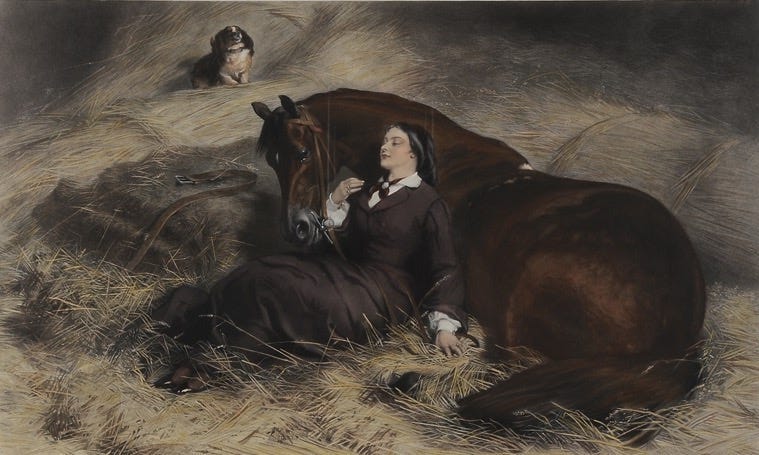
Name: Eliza Ann Gilbert
Alias: Annie Gilbert
Born: 2nd December, 1835
Died: December 1863
Spouse: None
Issue: Unknown son, born 1860
Childhood
Annie was born in Gosport, Hampshire, as the daughter of Ann and James Gilbert. Hers was a typical working-class family, with Annie’s father working as a labourer and her mother as a laundress. She was one of six siblings including two older sisters: Emma (b.1831) and Mary (b. 1834), who would go on to play important roles in her life.
The 1851 census, taken soon after Annie’s fifteenth birthday, reveals that an unusual family split had occurred in the years prior. She is recorded as living at 122 Sackville Street in Portsmouth with her two sisters and a four-month-old ‘Nephew’. Richard James Gilbert’s birth registration (see appendix) reveals that he is actually the son of seventeen-year-old Mary, who did not register the father. Presumably Mary’s pregnancy was the reason that the three Gilbert daughters split from their family home at such a young age.
The sisters next appear on record in 1855, when Emma Gilbert marries a Portsea-based royal artillery Captain — Hugh Stuckely Buck — and Mary gives birth to her second child. Sometime before April 1855 Annie and Mary had accumulated the funds to move to London. They lived together at 1 Richmond Place in St John’s Wood, an area notorious for its society of courtesans and kept mistresses.
The second baby, Frederick Gilbert, is registered with no known father at birth (see appendix), and it appears more likely now that Annie and Mary were engaged in some form of sex work in London.


Tattersall’s and Horse Training
After moving to London, Annie Gilbert was employed at Tattersall’s in Knightsbridge — the city’s premiere horse dealers. Working under Richard Tattersall, Annie was trained as an equestrian and sent out to model horses in hunts and in London’s Parks. She, like much of the sporty set in the city, could often be seen out riding along Hyde Park’s Rotten Row. Since Annie was working for Tattersall’s when she was introduced to William Powell Frith in 1856, we can assume that she was hired by the stables soon after her arrival in the city. Later, Frith would ask her why she had not married Richard Tattersall, since her clearly doted on her, to which she responded: ‘I wouldn’t ‘ave him, not if every ‘air of ‘is ‘ead was ‘ung with a diamond’.
In July 1856, Annie decided to leave Tattersall’s to set up her own business training horses for women riders. Her first premises were at ‘Mr. Howden’s Stables, York Gate, York Terrace’ in London’s up-market Regent’s Park. By June of the following year she had moved to ‘Mr Hetherington’s of Edgeware Road’ at 18 Connaught Terrace.
In 1858, Annie became one of the first pupils of the American horse-trainer John Solomon Rarey, who created the technique of Horsebreaking in order to tame aggressive horses. Using a leather strap to bind the horses’ legs, this method relied upon exhausting the horse into submission and has since come under significant criticism for weaponising the horses’ stress and panic levels. Nonetheless, at the time of its introduction to the British public it appeared to be a miracle solution, so was a skill highly prized in horse trainers.
In June 1858, a lengthy article praising Annie’s skill as a horse trainer appeared in the London Illustrated News, which recommended her as the most dependable in the country for preparing horses for women riders.
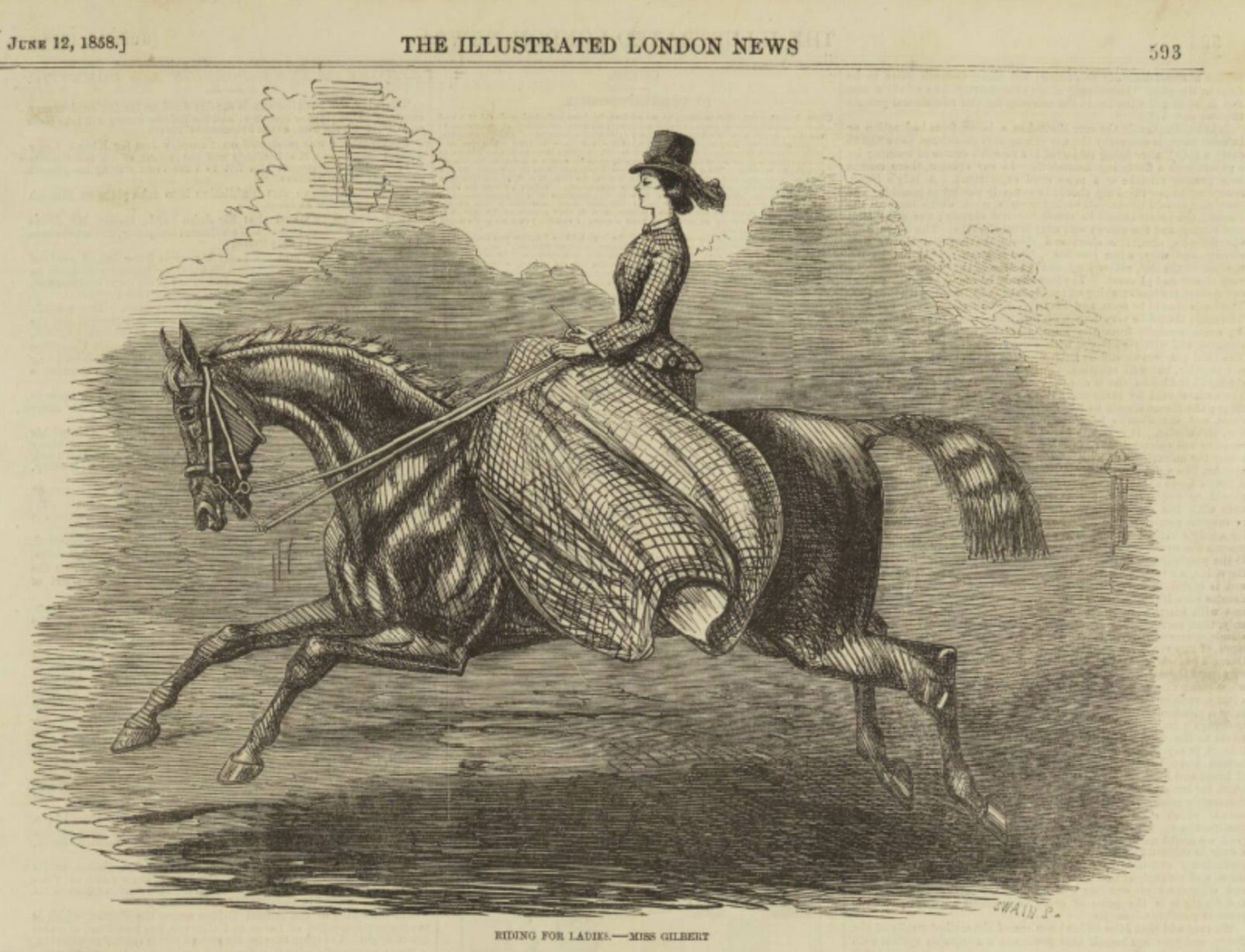
Annie’s profession was not without its risks. In late July 1857, whilst training a horse in Hyde Park, she was thrown to the ground and crushed. Her injuries were severe, and several newspapers documented the incident, adding that there was little hope held for her recovery. The accident caused serious concern, but thankfully Annie recovered and was back in the saddle writhing a few days. Perhaps in an attempt to reduce the harm to her business, she wrote to The Sun to clarify how the accident had occurred and how little damage had actually been done.
Starting during her time at Tattersall’s, Annie enjoyed riding with the Queen’s Hounds. The Master of the Hunt, Charles Davis, was a traditionalist, who rarely made allowances for women to join; ‘he made an exception in favour of a “Miss Gilbert” on account of her cheerful spirit and dashing riding’ explained Lord Ribblesdale, ‘but especially on account of her Spartan endurance of long rides home at hounds’ pace’. Annie could often be seen at the front of the pack in the Hunt’s scarlet uniform alongside her sporting rival, Elizabeth Reynolds, an older woman who ran a riding school in Brighton. On occasion the hunt was joined by Agnes Willoughby, another courtesan, but she was less readily accepted by the group.
Annie’s hunting achievements were frequently documented in newspapers, particularly Bell’s Life in London and Sporting Chronicles.
Derby Day
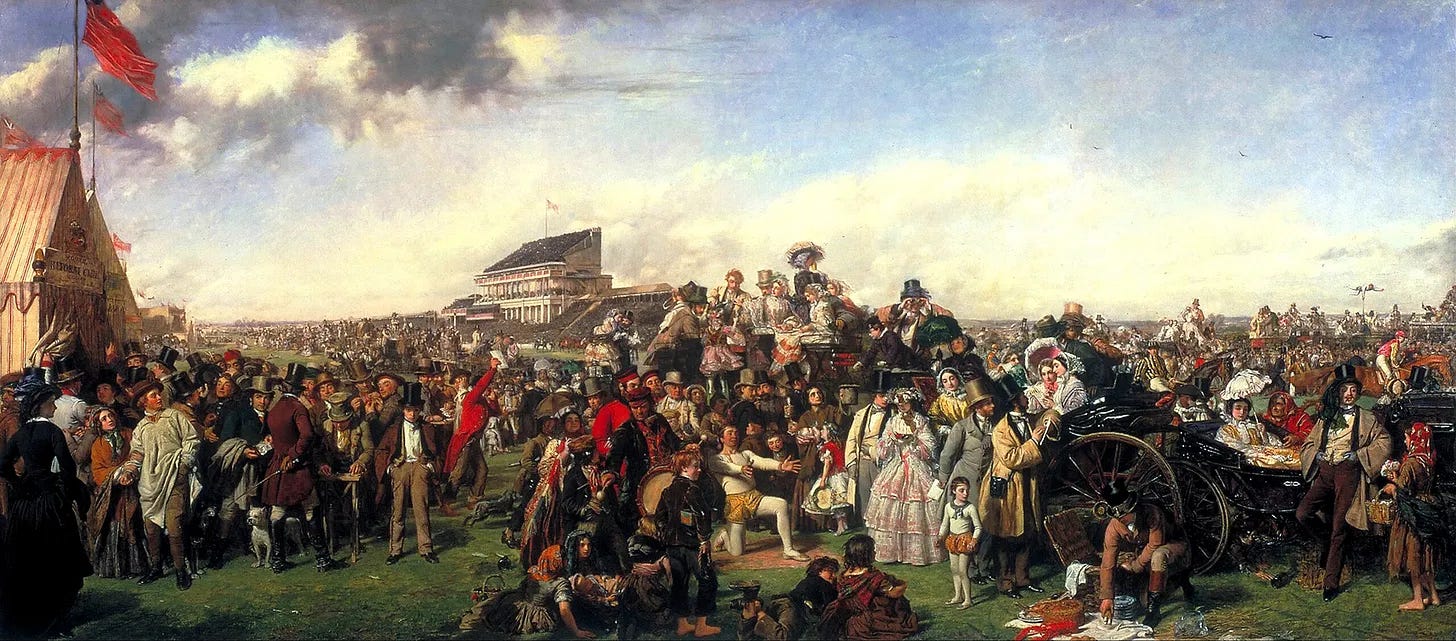
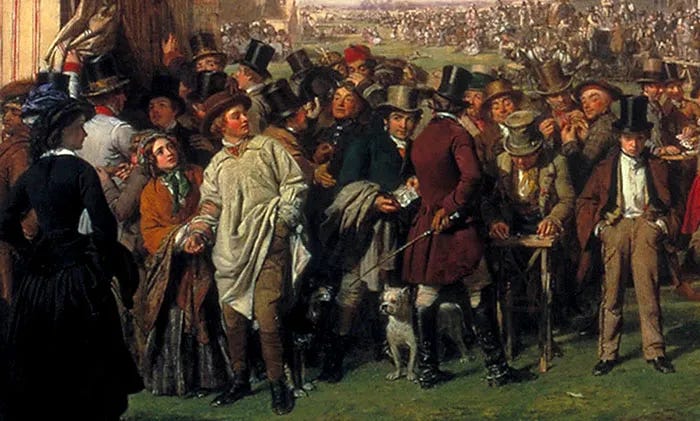
In 1856 Richard Tattersall introduced Annie to the artist William Powell Frith, who was looking for a model for his latest panorama. Derby Day was to be a busy scene of equestrian culture and mid-Victorian pleasure, for which an elegant Amazon in a riding habit was necessary. Currently on display at the Tate Britain in London, Annie is depicted at the extreme left of the canvas, surveying the scene.
Frith was smitten with her; ‘to those who remember the beautiful Miss Gilbert, my rendering of that witty, charming creature will not be satisfactory’ he wrote in his memoirs. Indeed, Annie is swallowed up by the busy canvas. She stands at the extreme left with the skirts of her riding habit hitched over one arm, facing away from the viewer with her face in shadow. She sat for free, and Frith offered to pay her with a print of the finished work. ‘In reply to my telling her that she would have to wait three years for the print, she said, “Ah! Never mind. I shall soon ride the time away”’.
The Duke of Sutherland Affair
During her first few years in London, prior to 1858, Annie began an affair with George Granville William Sutherland-Leveson-Gowe, Marquess of Stafford and heir to the Dukedom of Sutherland. Though it isn’t known how they met, both shared a love for horses and hunting, so it can be assumed that they ran in similar sporting circles.
With the patronage of a future Duke and income from a thriving horse-training business, Annie was able to move into an impressive house next to Kensington Palace Gardens in April 1859, which was attached to its own stable. 66 Queen’s Road was large enough for Annie to live with four domestic servants and a groom, and the stable was equipped for her to run her business entirely under her own superintendence for the first time.
But Stafford was already married, and kept his affair with Annie very poorly disguised. By Summer that year, it was widely known that ‘Stafford and Miss Gilbert’ had been, for some time, ‘too intimate’, and his wife, Anne Hay-Mackenzie, was threatening separation. Under pressure from his friends and after a personal warning from the Queen, Stafford was persuaded to let Annie go.
He entrusted her care to one of his friends, Lord Dufferin, of whom he knew Annie to be particularly fond. ‘She always talks of you with great affection’, he wrote, ‘you are everything that is kind and good and I am just the contrary’.
Lord Dufferin and the Mystery Son
Lord Dufferin, also known as Frederick Hamilton-Temple-Blackwood, first met Annie in 1858. He was living in Portsmouth, where he was overseeing the restoration of his yacht Erminia, and became acquainted with Captain Hugh Stuckely Buck and his wife Emma Gilbert. He first knew of Annie as ‘Mrs Stuckely’s sister’. Dufferin also knew the Marquess of Stafford, and so happily received the aristocrat and his new mistress when they came to visit for a sailing trip.
Dufferin was charmed by Annie, and began paying her court during her stay. With Stafford’s approval, he showered her with gifts of money and regularly went out riding together. Annie and Dufferin also began a healthy correspondence, but her letters from this period were later destroyed by Dufferin’s family in an attempt to disguise his relationship with a known courtesan.
For most of 1859 Dufferin was travelling on Erminia, but returned towards the end of the year to find Stafford in distress over the future of his marriage and his relationship with Annie. Dufferin consented to take on the role of Annie’s patron, and offered for her to stay at Dufferin Lodge in Highgate until the scandal died down. During her stay at the Lodge, Annie discovered she was pregnant — but whether the father was Stafford or Dufferin is unclear, and appears to have been unclear to Annie as well. Dufferin arranged for her to travel to Portsmouth to be with her sister Emma when the baby was delivered in the Spring of 1860, and as of yet no record of her son has been found.


In 1860, Dufferin and Annie visited Society photographer Camille Silvy in London, and their photographs remain in the day book records at the National Portrait Gallery.
The Shrew Tamed
Throughout her relationship with Stafford and Dufferin, Annie remained a popular figure in the London art scene. In 1858, soon after the completion of Derby Day, William Powell Frith introduced Annie to his friend and fellow artist Sir Edwin Henry Landseer.
He found her to be ‘rather too fast for me, sober as I have become’ but nonetheless was happy to have found a suitable candidate to model in a a group composition ‘in which she is number-one copper bottomed’. During the early stages of this painting, Landseer seems to have changed his mind in favour of a solo scene of Annie at work as a horsebreaker. She was thoroughly delighted with this development and showered praise upon Landseer, inviting him to parties and allowing him to take her and Mary Gilbert out to the theater. ‘I suppose she thinks my Picture will be a trump card for her’, he wrote to a mutual friend, explaining that Annie promised to reward him richly if the finished picture was a success.
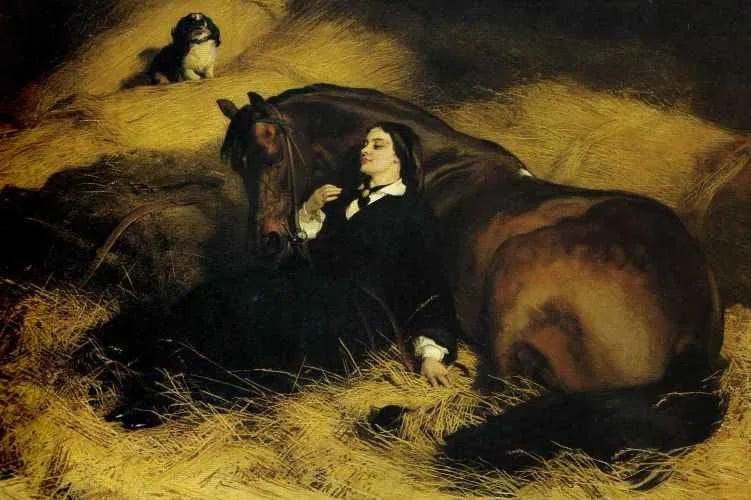
The painting — The Shrew Tamed — was first displayed at the Royal Academy in the Summer of 1861, almost two years after the Stafford affair had threatened to cause a scandal. In this case, nothing could be done to prevent a wave of sensation, and the painting triggered an outrageous response when it became clear to viewers that it was depicting a Pretty Horsebreaker — one of the dashing courtesans that used equestrianism to capture the attention of high-society men.
‘Time was, Sir’, huffed a lamenting aristocratic mother in a letter to the Times ‘when a Lawrence, and then a Grant, placed on the walls of the Royal Exhibition lovely pictures each season of daughters offered to the attention of England’s fashionable world’. Where once the Royal Academy had served as a space to advertise their ‘pretty, chaste, wares’ to the marriage market, it seemed instead to be platforming women of the demimonde; ‘The Pretty Horsebreakers occupy naughtily and temporarily where we should occupy en permanence’.
The painting was purchased immediately after the Royal Academy Exhibition by the Marquess of Stafford — now the Duke of Sutherland. I doubt his wife was particularly happy.
Later Career and Death
In 1861 Mary Gilbert left London for Bradwell, where she lived with her new husband and their infant daughter. Her two illegitimate sons were divvied out between her sisters, Emma taking in James, and Annie housing six-year-old Frederick. In August, Mary and her new family would set sail for Australia, leaving the boys behind for good.
Information on Annie becomes scant after 1860. She placed no more advertisements for her horse training services, and appears in only one further hunting report — only as a reserve, however. It is possible that the extreme public backlash to the Landseer painting was the final nail in the coffin for her reputation, and Annie felt it wise to retreat from her social circle. More probable, however, is that her health was beginning to decline. Even during the time of their affair, Lord Stafford had observed that Annie ‘had a weak heart’, and by the dawn of 1864 Annie Gilbert was dead.
‘While working hard in her profession, riding frequently ten different horses a day, she was suffering very much from a disease of the heart’ wrote the hunting correspondent for Bell’s, ‘which ultimately assumed such proportions as to compel her to give up her avocations and retire to a private life’. It was tuberculosis which had ultimately struck her down; ‘death came in the prime of her youth and beauty’ lamented Frith.
Annie had travelled to the South coast, to a town like Hastings or Torquey, where doctors prescribed the crisp sea air to patients when all else failed. She didn’t stay long, and in the final weeks of 1863, she returned to London. Annie spent her final days at number 24 St James’ Square — one of the smaller properties on a street otherwise encircled in aristocratic city homes. Her eldest sister Emma, who had recently moved with her husband to Hammersmith, was presumably her companion. After Annie’s death she arranged for her burial at Highgate Cemetery, in a family plot where her husband would later be interred.
Annie’s Legacy
Lord Dufferin remained in contact with the Gilbert family after Annie’s death, and made occasional visits to Emma in the years that followed. With no children of her own, she was left to raise her two nephews, James and Frederick.
In 1894, whilst serving as Ambassador in Paris, Dufferin received a letter from James Gilbert requesting assistance in finding employment for his son in the colonial police force. It triggered the start of a correspondence that revolved around Annie’s memory. In return for his help, Dufferin requested a sketch of Annie that he had completed during the time of their affair, which had subsequently been inherited by Emma after her sister’s death. She would not part with it, not even after Dufferin sent another sketch to replace it.
Instead, James sent a miniature of Annie that dated to 1861 and a photograph of his twelve-year-old daughter Mary who, he explained, bore ‘marked indications of an eventual resemblance to my affectionately remembered Aunt’.
Appendix


Sources used:
Gailey, Andrew. The Lost Imperialist: Lord Dufferin, memory and mythmaking in an age of celebrity. John Murray, 2015.
Ribblesdale, Thomas Lister. The Queen's Hounds and Stag-hunting Recollections: With an Introduction on the Hereditary Mastership, by Edward Burrows, Comp. from the Brocas Papers in His Possession. Longmans, Green, and Company, 1897.
Frith, William Powell. My autobiography and reminiscences. Bentley, 1889.
Ormond, Richard et al. Sir Edwin Landseer. London: Thames and Hudson, 1981. Print.
Census records:
1851 Census
Class: HO107; Piece: 1659; Folio: 614; Page: 26; GSU roll: 193565-193566
1861 Census
Class: Rg 9; Piece: 12; Folio: 96; Page: 30; GSU roll: 542556
Burial Record:
London Metropolitan Archives; “London, England, UK” ; London Church of England Parish Registers; Reference Number: Dl/T/063/021
Periodicals:
A Sorrowing Mother for Seven of Them, ‘A Belgravian Lament’, The Times, June 27, 1861.
‘Riding for Ladies: Miss Gilbert’, Illustrated London News, 12 June 1858
‘The Late Miss Gilbert’, Bell’s Life in London and Sporting Chronicle, 20 February 1864
So fascinating and well-researched! Thank you for sharing Annie's story with us :)